
Seam Welding · Forged Discs
Seam Welding
Discs and wheels for continuous hermetic welding. Critical applications where leak-tightness is mandatory: fuel tanks, transformers and radiators.
What is Seam Welding?
Seam welding is a resistance welding process that produces a continuous, hermetic joint between two or more metal sheets. Unlike spot welding which creates individual points, seam welding generates a continuous weld bead.
The process uses disc or wheel-shaped electrodes that rotate while applying electrical current and pressure. The current can be continuous or pulsed, creating either a solid bead or a series of overlapping spots (mash seam) that ensure total leak-tightness.
Seam Welding Products
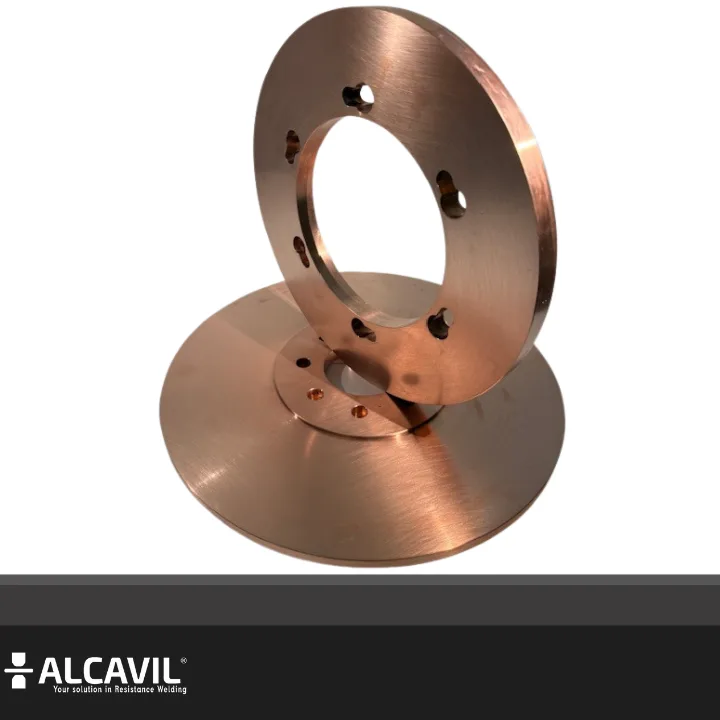
- Forged Discs (Any Diameter) We manufacture discs of any diameter per customer specification. Compact, radially oriented grain structure, zero internal porosity. Class 2 Copper (CuCrZr or CuCr).
- Custom Profile Wheels Special profile machining per customer drawing. Radii, chamfers and specific geometries for each application.
- Grinding / Re-profiling Service Restoration of worn discs to their original profile. We extend the service life of your existing discs by up to 50%.
Technical Differentiator – AWS J1.3 Class 2 Copper
Zero Porosity: Our forged discs in Class 2 Copper (C18200/C18150) per AWS J1.3 guarantee a compact, radially oriented grain structure. Result: consistent hermetic seams and up to 40% longer service life than cast discs.
Critical Applications
Seam welding is essential in applications where leak-tightness is mandatory:
- Automotive Fuel Tanks Hermetic sheet joining for fuel containment. 100% leak testing.
- Electrical Transformers Dielectric oil containers. Hermetic welding to prevent leaks and contamination.
- Radiators and Heat Exchangers Radiator tanks, heat exchangers. Critical leak-tightness for cooling fluids.
- HVAC Ducts Air conditioning and heating ducts. Leak-free joints for system efficiency.
- Pressurized Containers Pressure vessels, cylinders and special tanks. Welding that withstands internal pressure.
Why Forged Discs?
The difference between a forged disc and a cast or bar-machined one is significant:
- Oriented Grain Structure The forging process aligns the copper grain radially, improving thermal conductivity and mechanical strength.
- Zero Porosities Casting may contain microporosities that weaken the material. Forging eliminates them completely.
- Longer Service Life Up to 40% longer life compared to conventional cast discs.
- More Consistent Welds Homogeneous material produces uniform and hermetic seams repeatably.