

Weld Nuts · Weld Studs · Consumables & Tooling
Projection Welding Electrodes & Tooling
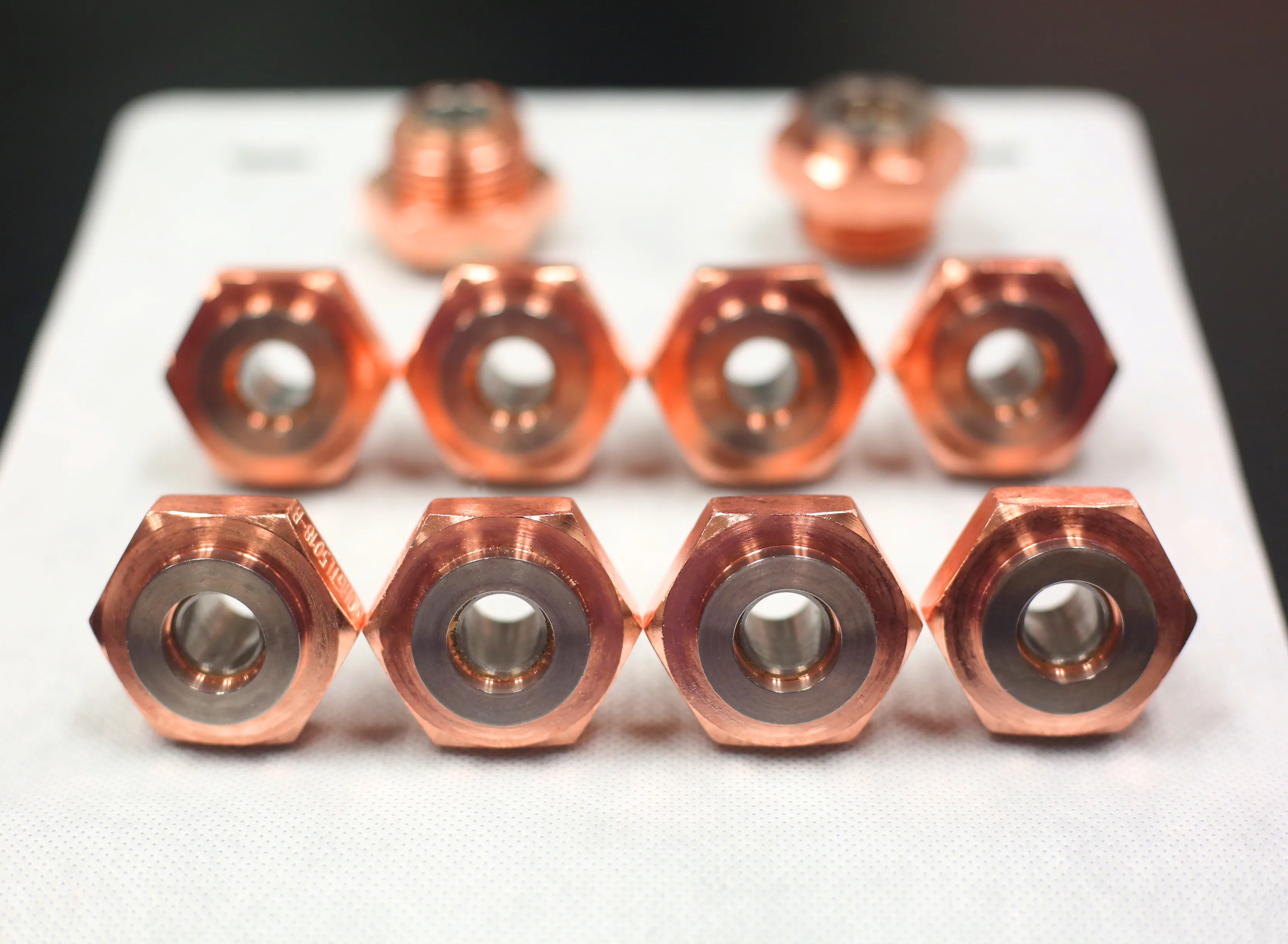
Electrodes, consumables and tooling for nut and stud welding in OEM automotive production lines. We manufacture from the electrode body to the refractory insert, all under one roof.
What is Projection Welding?
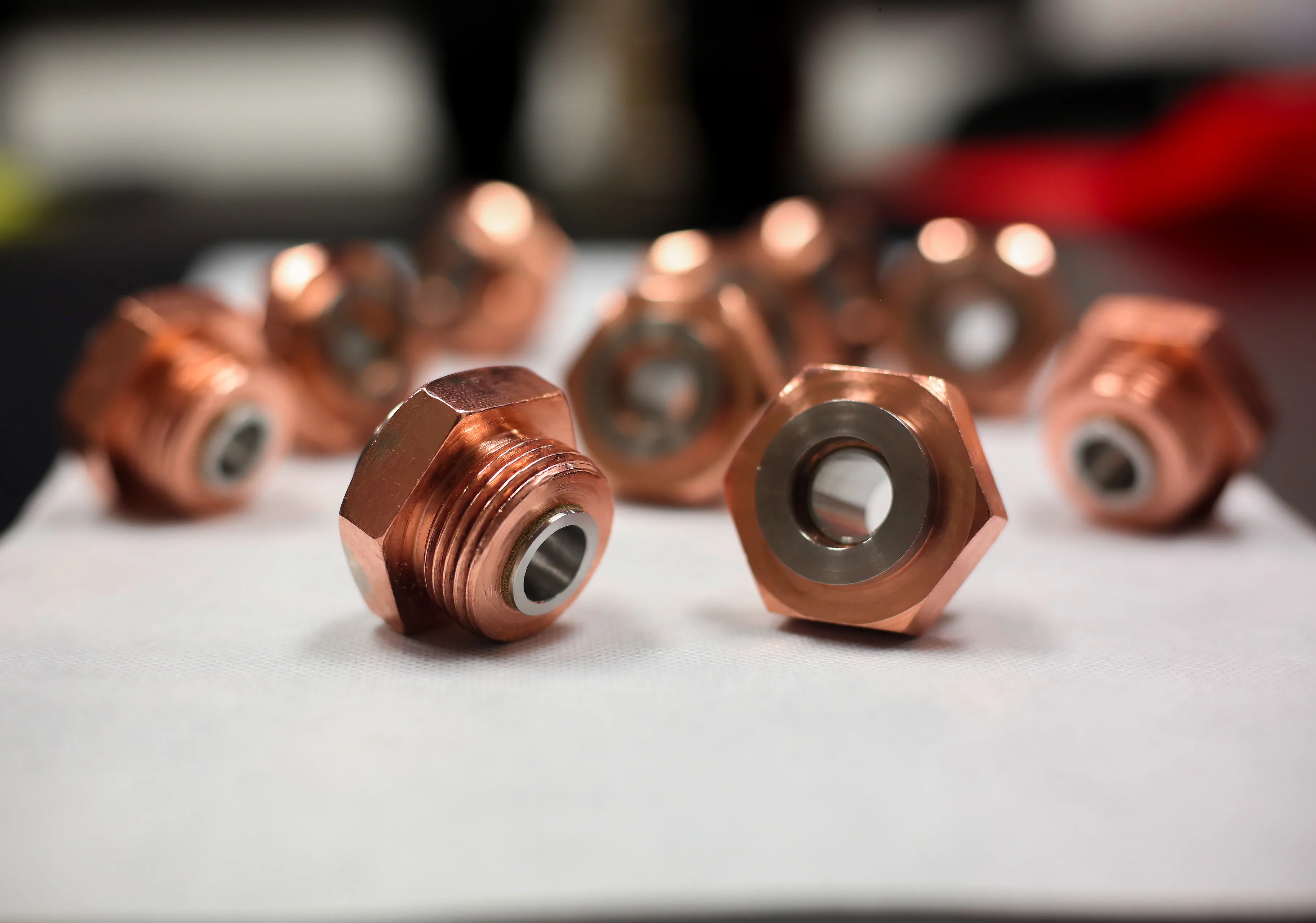
Projection welding is a resistance welding process that concentrates electrical current at specific points through preformed protrusions on the workpiece. This allows high mechanical strength joints in critical automotive applications.
This process includes nut welding for M4-M12 nuts and stud welding for studs and threaded fasteners on automotive chassis. The electrodes require special materials that withstand repeated impact and high contact pressures.
Projection Welding Consumables
A projection welding station consumes more than electrodes. We supply the full set of projection welding consumables — electrode bodies, CuW inserts, guide pins, threaded holders and shunts — so a line can be maintained from a single supplier instead of coordinating four.
- Electrodes with CuW Insert (Elkonite Class 10-12) High-strength brazing with silver alloy for maximum conductivity and impact resistance. Elkonite inserts combine copper's conductivity with tungsten's hardness.
- Ceramic Guide Pins (Zirconia, Si₃N₄) and KCF Insulating materials for precise nut centering. Low spatter adhesion, maximum service life. Silicon nitride ceramics offer better thermal resistance.
- Stainless Steel Pins Economical option that absorbs impacts without breaking. Require electrode with insulating bushings to avoid short circuits.
- Threaded Electrodes and Bases In-house manufacturing of holders and bases for quick change in production lines. Standard and special threads as required.
- Shunts / Flexible Connectors Braided cables and flexible connectors for current bypass. High-purity electrolytic copper for minimum resistance.
Technical Differentiator – AWS J1.3
Superior Metallurgical Bond: Our Elkonite inserts (CuW Classes 10-12 per AWS J1.3) are joined to the electrode body through silver alloy brazing. This metallurgical bond ensures continuous electrical conductivity and mechanical resistance to repeated impact, outperforming conventional mechanical joints.
Typical Applications
Our projection electrodes are used in major automotive OEMs for:
- Weld Nuts M4 to M12 Component attachment on body-in-white, chassis and subframe
- Weld Studs Structural anchors on floors, roofs and side panels
- Brackets and Supports Attachment elements for harnesses, tubing and auxiliary components
Weld Stud and Ring Weld Tooling
Stud welding shifts the problem: instead of centering a nut, the electrode has to locate a weld stud or an annular projection and hold it square to the sheet while the current passes. The wear pattern is different — less spatter on the pin, more mushrooming at the face — so the tooling is designed around it.
Projection Weld Tooling We Manufacture
- Weld Stud Electrodes and Locators Electrode faces with pockets or counterbores that seat the stud head, keeping the shank perpendicular to the panel. Machined to drawing for each stud geometry.
- Ring Weld and Annular Projection Electrodes Flat and profiled faces for continuous ring projections, where current has to distribute evenly around the full circumference instead of concentrating on discrete bumps. Class 2 and Class 3 bodies, CuW insert where the duty cycle demands it.
- Backups, Anvils and Lower Tooling Lower electrodes and backing blocks that carry the reaction load without deforming. Sized to the press and holder already installed on the line.
- Holders, Bases and Adapters Threaded and tapered mounts for quick change during production. We reproduce the interface of the tooling already in service so no press modification is required.
Reverse Engineering from a Worn Part
Projection tooling is rarely catalog. If the original drawing is gone, send the worn electrode — we measure the mounting interface and the working face and manufacture a replacement to ±0.0002" (±0.005 mm). Material selection follows AWS J1.3 specifications for the class involved.
Stud and ring applications run hotter at the face than nut welding, which is where insert material selection decides electrode life. See Elkonite CuW Class 10-12 for high-pressure faces, or Class 3 CuNiBe when the body itself carries the load.
Guide Pins for Nut Welding
The guide pin centers the nut on the stamping so the projections align correctly with the sheet metal. Available in Ceramic (Zirconia, Si₃N₄), KCF and Stainless Steel - each material with different advantages for your application.
Main Function: Centering
In projection nut welding, the nut has clearance - meaning it moves on the stamping. The guide pin has the diameter of the stamping hole and the nut's inside diameter, centering both parts so the projections align correctly.
The Problem: Weld Spatter
During projection welding (high amperage, low voltage), molten metal can spatter and adhere to the guide pin. These weld beads make centering the next nut difficult and can damage the threads.
When Do I Need an Insulating Pin?
- With insulating bushings (fiberglass + stainless): The electrode is already insulated, you can use stainless steel pins
- Without insulating bushings: You need insulating pins (ceramic or KCF) to prevent current from passing through the pin
Guide Pin Material Comparison
Ceramic (Zirconia, Si₃N₄)
Ideal for: High volume, 24/7 production
- Maximum operational life
- Total electrical insulation
- Easy cleaning - spatter doesn't stick
- Higher initial investment (better long-term ROI)
KCF (Potassium Titanate)
Ideal for: Medium volume, cost/life balance
- Balance hardness and mechanical strength
- Complete electrical insulation
- Less adhesion than stainless
- Moderate cost vs ceramic
Stainless Steel
Ideal for: Low volume, emergencies, impacts
- Absorbs impacts - doesn't break, only bends
- Easy to straighten or replace
- Immediate availability
- Requires electrode with insulating bushings
Available Sizes
| Metric Size | Pin Diameter (mm) | Typical Application |
|---|---|---|
| M4 | 3.2 - 3.5 | Electronic components, small brackets |
| M5 | 4.0 - 4.3 | Interior brackets, trim |
| M6 | 4.8 - 5.2 | Most common - BIW, brackets |
| M8 | 6.5 - 7.0 | Suspension, structural |
| M10 | 8.2 - 8.8 | Chassis, subframes |
| M12 | 10.0 - 10.5 | Heavy duty, structural applications |
Recommendation by Application
| Situation | Recommended Material | Reason |
|---|---|---|
| High volume 24/7, electrode without bushings | Ceramic (Zirconia) | Maximum life, total insulation, easy cleaning |
| Hot stamped / Laser cut | Ceramic (Zirconia) | Greater abrasive wear resistance |
| Medium volume, moderate budget | KCF | Good cost/performance balance |
| Application with frequent impacts | Stainless + bushings | Doesn't break, absorbs impacts, easy to straighten |
| Electrode already has insulating bushings | Stainless Steel | Economical, electrode already insulated |
| Special nuts, complex design | Consult | We evaluate design to prevent fractures |
Custom Designs: If your nut or stamping has special geometry, we manufacture custom guide pins per drawing. It's important that the design avoids forced corners or stress concentrators that can cause fractures in ceramics or KCF.